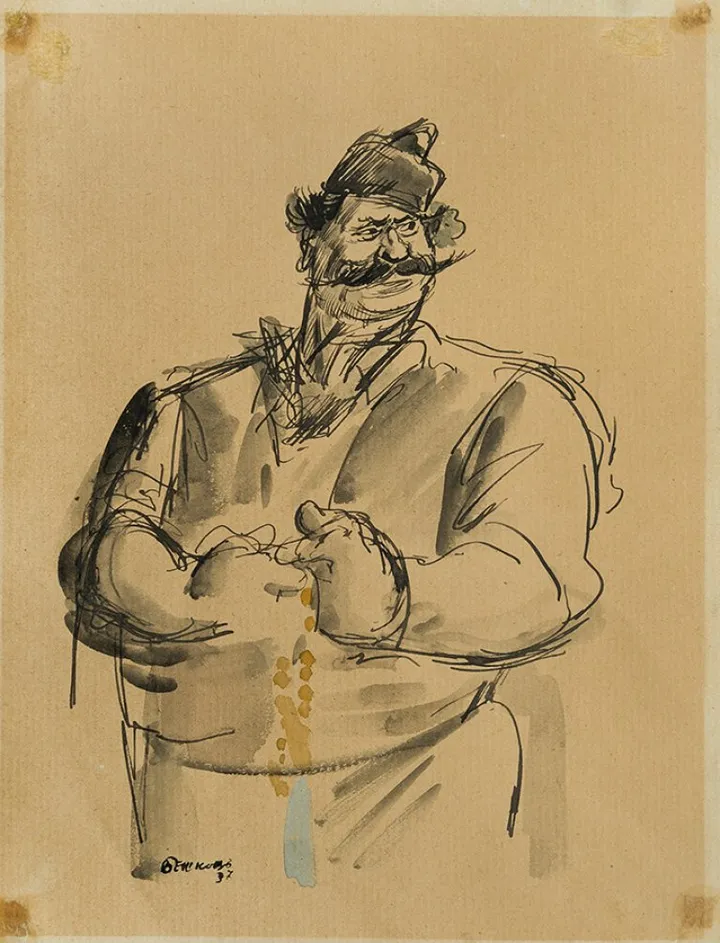
The Law of Saps and Hustlers
Or the ethics of hustling saps — an in-depth philosophical and sociological analysis of one of the most destructive logics in contemporary society.

(AI-translated)
“As long as there are saps, there will be hustlers,” says our “average” Bulgarian with a subtle smile and a pretension of wit. Yet even if we cannot meet such an average person on the street, few have not encountered this line of thinking in their daily lives. Indeed, reader, if you look closely around you, it is not at all unlikely that you will notice how everything is marked, even poisoned, by this very logic. The present article sets itself the goal (pretentious though it may be) of carrying out a much-needed critique of what we can safely call the “hustler’s ethics.”
The law described above is understandable—defining the one requires defining the other: as long as there are no saps, there are no hustlers, but where there are no hustlers, there are no saps. Consequently, saps are a necessary prerequisite for the existence of hustlers, and vice versa. Delineating a genealogy of these concepts, however, is not the task of this current (and humbler) study. In other words, whether the chicken or the egg came first is a question to which we will not give a definitive answer here. The actual task is to describe another path of development, namely: what if it turns out that hustlers, in the end, turn out to be the biggest saps of all? We will illustrate this overlooked but highly consequential circumstance with a few examples, but first let us turn to etymology.
“Sap” (balăk in Bulgarian) originates from the Turkish word for fish, balık, conventionally used by us to mean “naïf, fool.” On the other hand, “hustler” (tarikat in Bulgarian) originates from the Arabic ṭarīqa (طريقة), meaning “method, path, way.” Originally used in mystical Islam (Sufism) to denote a school for spiritual elevation, we now use it to call someone a “cunning trickster.” We can also interpret it as “one who finds the way, resourcefully clever,” and in certain contexts, we even use it as a synonym for “resourcefully adaptive.”
Indeed, the theoretical framework of the sap and the hustler allows us to achieve a (though not overly deep) analysis of many real situations. But before we illustrate this, let the reader first do what is necessary and answer the following questions for themselves:
“Does our society have a problem with corruption?”
“Does our society have a problem with the inefficiency of many institutions?”
“Is justice absent in our society?”
“Is there a systemic disregard for the law in our society?”
“Is there an excessive disregard for rules in our society?”
Agree that few are those who would not answer with a “Yes” to everything posed above. And now, let us examine through examples the essential causes of these problems. Imagine the following scenarios: Gosho decides to buy his university diploma, Pesho chooses to cut in line, Maria finds it necessary to cheat on her exam, and Jasmina, for her part, finds a job for her cousin, even though she knows very well that he is unqualified.
But why do we list these cases? Because each one of them allows us to apply our forged and culturally conditioned theoretical framework. Gosho is a hustler; those who study to gain (first) knowledge and (second) a diploma are saps. He has “found the way.” Pesho’s case is similar; he even says to himself: “Ha—why should I wait? I’m no sap!” and asserts his dominance. Maria holds a similar opinion; she doesn’t think it is necessary to push herself or acquire competence—after all, the goal is simply to obtain that highly desired university degree (desired only by her parents, for prestige), while the saps can beat their heads against books, since “that’s all they are smart enough for.” And last but not least, Jasmina “plays it clever” by “helping” her cousin, so they both come out as hustlers. She, of course, does not realize the web of implicit obligations directing her action, nor her expectation of future reciprocal favors from her cousin, but that is of no consequence—what matters (as folk wisdom goes) is not necessarily to find a person for the job, but rather a job for the person.
But is it true that each of the characters we have summoned in this text deserves prestige and reverence because of their unseen and unheard-of wisdom, reasonableness, and wit? Because here is what each of them actually does:
- Each of them lies to themselves. Consequently, they act unjustly towards themselves.
- Each of them lies to others. Consequently, they act unjustly towards others.
But someone might say: “No! How so—they are not bothering anyone?”. It will become clear in the course of the argument precisely whom they are bothering (hint: mostly themselves). And in order to explain what justice really consists of, the reader must trace what is visible and what is invisible.
Along with Gosho, we see his diploma. What we do not think about is why this diploma was created, what it measures, and what its purpose is. Additionally, what remains invisible is what he has done to the credibility of that measurement. First and foremost, he validates the practice of denying any objective criterion of competence. A diploma is supposed to represent acquired skills and knowledge, signaling them to employers and the rest of society. Thus, Gosho becomes an accomplice in the mass murder of meritocracy. He makes possible a society in which money, rather than labor, knowledge, and skills, brings “benefits.” But still, this may seem too abstract. What happens, however, when someone like Gosho operates on you? When you have an illness, or when your close relative or child does? What if Gosho himself has to visit a healthcare facility in an emergency, or drive on a road designed by other goshos? If your life depends on such a “hero” and “hustler,” will you still call him that? It is highly doubtful. The fact that there is injustice towards those labeled as “saps” is indisputable and needs no deep argument, but what is also invisible is that Gosho condemns his children, grandchildren, great-grandchildren, etc., to live in a society devoid of justice, meritocracy, and competence.
And regarding Pesho—what remains invisible is that if we all start cutting in line, we will find ourselves in an infinite cycle of cutting. Alternatively, the last to arrive will be served first, and the first last, which (let us agree) is entirely meaningless.
And with Maria, the case, alas, is no rosier. She deludes herself—pretending that the high grade she obtained equals knowledge or holds any value whatsoever. Worse, she lies to everyone around her. But leaving that aside, is she not in the highest degree unjust to the hard-working, the genuine students, and those who respect the rules and the spirit with which the entire system of evaluation—and why not the educational system itself—was conceived? And if the reader still harbors any slight doubt that Maria has fooled anyone but herself (because she is not an isolated element from the rest, nor do her actions vanish somewhere unknown and inconsequential in space—they carry real consequences), then we must focus on the most disastrous effects. By acting unjustly, she does so against the rest of humanity of over 8 billion people, because justice applies to all of them. But why limit ourselves to the living? Maria decides to spit upon the graves of all Enlightenment thinkers who envisioned reason in her. Not only that, but she condemns to a life in an anti-cultural environment (one which, in a highly paradoxical way, has institutionalized the practices of destroying culture)—an environment toxic to the individual, the good, and the righteous—all those who are yet to be born, to grow up in it, and eventually to become its (unfortunate) carriers.
And what does Jasmina do? She differs in no way from the other three cases, except that by doing a “favor” for her “cousin,” he now feels obligated (and is implicitly obligated—our cursed Balkan “culture”) to return the gesture. And thus to close his eyes when she violates the law, or to help her find a place where a place should never have been found for her.
But why all these reflections? “So what?”. Well, here is why—Gosho, Pesho, Maria, and Jasmina are actually our ministers, managers, builders, architects, psychologists, economists, sociologists, geologists, politicians, etc. Because lies at the micro-level (that is, in everyday life) never remain at the micro-level, but shape the macro-level (the governance structure). They have a tendency to grow and grow, because one lie requires another to hold itself up. And so it goes, all the way to the top of the “ladder.” The one who governs us is indeed nothing other than our neighbor, but a hundred times more empowered. What if it turns out that he is our product, and not we his? What if, in fact, he does not “govern” us, but we govern ourselves through him? None of these characters is some external body dropped from above or taken from elsewhere, Mars perhaps. He is an expression of the prevailing moods and tendencies in what we call our (anti-)culture. And no—the solution does not consist in “strict punishments,” because monitoring the rules falls upon Tosho, who in turn has found a way to do it without a diploma (imagine that!). The problem is deeper: cultural.
Some of the hustlers, however, might mistakenly think that the structure making their hustling possible is eternal. Remember that it is precisely the lives of your children that will depend on people just as incompetent as they are. And since we live in a system with high social mobility (the opportunity to rise), but also with the risk of downward mobility—it is always possible that from hustlers you will turn out to be the most despised saps (adopting your own understanding of the categories).
And so, it is time to answer the question: “Who is the real sap?”. The sap is the one who does not follow the rules. Those who think of themselves as having “found the way” have indeed found no way at all. They are merely destroyers of culture without realizing it. Conversely, the real hustlers are the “saps” who cultivate virtues within themselves and consciously follow the rules.